Cold-Knowledge Blind BoxEpisode 40
Why Are Western Steaks Always Rare?
When a Western restaurant asks how you want your steak cooked, it's not about raw meat. It's about getting the beef's fibers and temperature right.
Hi everyone, welcome to Cold-Knowledge Blind Box. This episode is about steak.
"How would you like your steak cooked?" This is probably a puzzle many Chinese people face when they walk into a Western restaurant to order steak. Wait, isn't steak just beef? Shouldn't it just be cooked until it's well done and brought out? Why do they keep asking how I want it done?
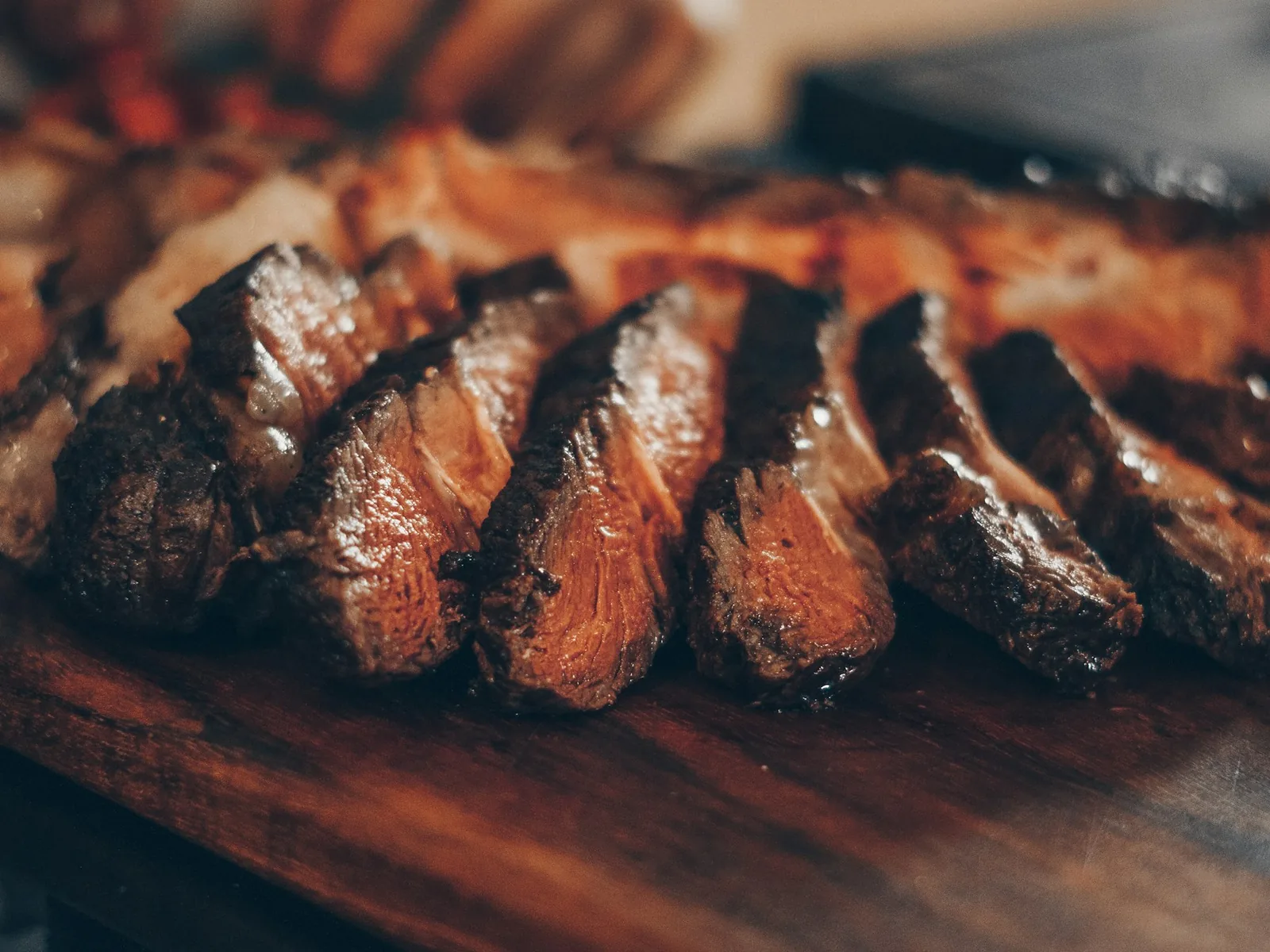
In the Western world, steak doneness is classified into five levels based on the temperature at the center: blue, medium-rare, medium, medium-well, and well-done. Americans and Europeans have an almost fanatical love for the range from medium-rare to medium-well, the steak that's "seared on the outside, pink inside, tender, and with red juices that run when you cut it." When steak arrives at a Chinese dinner table, though, a medium-well steak with no visible "blood" is the bottom line for most people.
So why do Americans and Europeans skip well-done and insist on "half-raw" steak? And how is steak different from ordinary beef?
Picture eating a steak. A cooked steak sits on your plate, with a knife and fork on each side. You stab the fork into the steak to hold it in place, use the serrated knife to cut it into small pieces, red juices run out, and you bring each bite to your mouth and chew slowly. The whole sequence flows smoothly and elegantly. It really is elegant.
But this "stereotyped," civilized way of eating steak doesn't have a long history. It only became popular in the early twentieth century. The word steak comes from the Scandinavian word for a thick slice of meat placed on a grill. In the Middle Ages, steak wasn't particular about which cut you ate or about etiquette. Meat was simply set over an open fire, and ordinary people ate it with their hands. Yes, steak was originally finger food. Forks didn't become common in Europe until much later.
Today, "steak" refers more to high-quality beef from parts like the sirloin and rump, usually cut into thick slices and cooked by grilling or pan-frying. Even the idea that "steak is better than beef in general" has been quietly instilled in consumers' minds. This "steak is more premium" impression was shaped by commerce and table manners together.
In the second half of the nineteenth century, as the major railroad lines crossing the United States from east to west were completed, the Atlantic and Pacific were linked by commercial arteries. Snowflake beef from the Chicago stockyards began to sweep across the country. Beef gradually came to be shaped by Americans as a food that symbolized power, masculinity, race (in the social context of the time), and economic success. Based on flavor, tenderness, juiciness, maturity, and marbling fat content, the US developed a grading system for beef, from canned minced meat up to snowflake steak. Only the top three grades, Prime, Choice and Select, with marbling of roughly 3% to 11% and fine, firm, tender meat, were suitable for steak. The parts of a cow that meet these conditions are mainly located above the sides of the spine.
Europe and America have a highly developed livestock industry. Cattle weren't raised to plow fields, but for milk and meat. So the muscles along the sides of the spine are mainly used to control the bending of the backbone and rarely move vigorously, and their muscle fibers are finer. On top of that, selective breeding of beef cattle has increased the fat content along the back. Faced with steaks rich in marbling and tender, shrewd butchers moved away from the rough method of "grilling until fully cooked over a high flame." Among grilling, roasting, braising, and boiling, they chose "pan-frying and grilling" as the methods that best bring out the aroma of fat and preserve texture. They cut the most tender tenderloin from the loin and the sirloin from the back loin separately, giving them elegant names. Combined with the refined dining rituals of French cuisine, steak consumption was tied to social class: clean, crisp napkins, silverware with engraved patterns, and a glass of tannic, aged Barolo from Italy. The once-rough barbecue thus completed its "class ascent."
So why do Westerners love "half-raw" steak? Here we need to introduce a concept: myofibrillar protein. It takes part in muscle contraction and affects the meat's water retention, firmness, and tenderness. Research on how cooking doneness affects myofibrillar proteins in beef notes that as core temperature rises, the surface hydrophobicity of myofibrillar protein keeps increasing. Put simply, it becomes better at "locking" juices inside the meat. At the same time, the myoglobin and pigments in the muscle begin to denature. Using a metal pan as the heat conductor, high heat creates the Maillard reaction on the surface of the steak, forming a roasted aroma. Keeping the interior pink and red in a half-raw state creates an excellent contrast in texture and flavor. This range generally corresponds to medium-rare through medium-well, with a juicy, tender mouthfeel. But when the core temperature exceeds about 65°C (past medium-well), myofibrillar proteins contract sharply, and the meat loses its juices like a sponge being wrung dry, becoming dry and tough. It's no wonder many people find well-done steak tiring to chew.
Interestingly, medium-well, the doneness many Chinese people prefer, sits right at the threshold where protein denatures. It avoids the psychological discomfort of red juices while still keeping much of the tender texture.
For many older Chinese people, steak isn't a familiar ingredient. But in the Chinese culinary context, steak with its "fancy outfit removed" is essentially beef tenderloin, known in Chinese as beef strips (牛柳). The basic approach to cooking Chinese-style beef tenderloin is to slice, cut strips, or mince it, and then either stir-fry it in hot oil or blanch it in boiling water. It's usually cooked through much more thoroughly.
So the question is: if steak tastes best at medium or medium-well, why doesn't traditional Chinese cooking have anything like a thick-cut, half-raw pan-fried steak? This may have to do with the high shear force of Chinese yellow cattle. Simply put, tenderness is perceived as "how easy it is to bite and how much residue is left after chewing." Chemically, it's measured by shear force: the higher the shear force, the less tender the meat. One study notes that the shear force of the most common local Chinese yellow cattle is about 8 kg, while Angus cattle come in at only about 4 kg. Frankly, the tenderness of yellow cattle really does fall short of some typical beef breeds.
But this also has to do with the resource endowments of civilizations. China's traditional agriculture was based on intensive, meticulous cultivation, and cattle were first seen as efficient farm tools, almost equivalent to today's high-load tractors. "Cattle are the foundation of farming," and raising them was more about labor than eating. Ancient China also long banned the private slaughter of farm cattle, so ordinary people rarely had a chance to eat beef. Even when they did, it was usually an old or overworked plow ox. Plowing is high-intensity labor, so farmers had to breed and select sturdy, strong yellow cattle to do the job. Day after day of hard work made their muscles more developed, and their muscle fibers thicker and longer. That's good for farming, but it makes the meat coarse and firm to eat. Even the most tender cut of the whole animal, the tenderloin, is no exception. Looking at historical paintings of "ox plowing a field," you can see that the strength of the neck and back makes the longissimus dorsi (including the area corresponding to the tenderloin) the main load-bearing muscle in plowing.
By contrast, meat breeds like Angus and Wagyu either spend their lives grazing on pasture to fatten up before slaughter, or eat feed in a barn to put on meat, and hardly work at all in their whole lives. This keeps their muscle fibers fine. Because breeding has gone in different directions, traditional Chinese cattle, bred for farming, developed muscular, hardworking yellow cattle, while Europe and America, breeding for meat, developed more tender varieties. Add to that the fact that "they have to do farm work" further weakened the meat quality of yellow cattle.
Still, as a country that is "the best at eating," China, even when dealt a hand where beef texture doesn't have the advantage, uses clever cooking to make it delicious. The approach we mentioned earlier is to slice the tenderloin thinly as preparation, then stir-fry in hot oil or blanch in hot water, shortening the cooking time and reducing protein contraction and juice loss. The representative dishes are stir-fried yellow beef and Chaoshan beef hot pot. Faced with the same question of "how to make beef tender," Chinese and Western cooking, each drawing on its own resources and culinary traditions, has given two delicious answers: the West found its answer in "thick cuts with precise temperature control," and the East found its answer in "knife work and quick cooking."
Today, with American steak culture spreading around the world, thick-cut steak has become a common ingredient in China too. When in Rome, do as the Romans do: Chinese people who can't get used to the classic half-raw style have worked out their own "new Chinese steak" methods, such as marinating before frying, wrapping in a thin layer of starch to lock in moisture, or simply dropping the steak into a hot pot and dipping it in sauce. Whatever the method and ingredient, when we pick up a piece of medium-well steak as a compromise, or boldly try a medium-rare one as an adventure, the clink of knives, forks and chopsticks might be carrying the most moving harmony: the pursuit of ultimate flavor always transcends the distance of culture and time, reflecting humanity's longing for a good life.
Alright, that's it for this episode of Cold-Knowledge Blind Box. See you next time.